

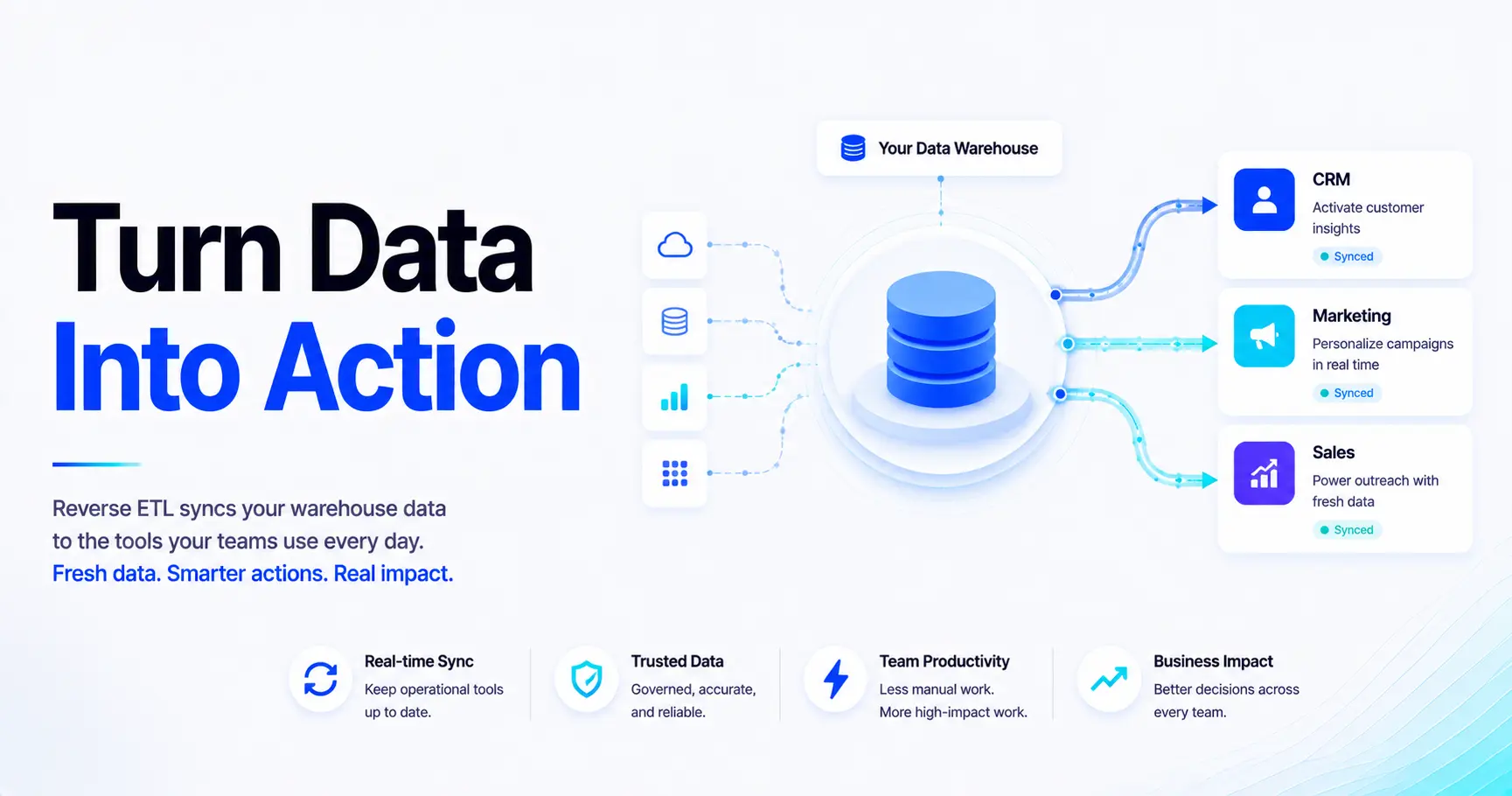
You Don’t Need More Data — You Need It in the Right Place
Many companies have centralized their data into warehouses and lakes and invested heavily in dashboards and analytics. Yet when business teams open the tools they use every day — CRMs, support systems, ad platforms — the data they need still isn’t there. Data lives in the warehouse and dashboards. Action happens elsewhere.
That disconnect creates friction: sales teams miss signals, support teams work without context, marketing wastes money, and products react too late. Reverse ETL bridges this gap by automatically pushing reliable, modeled data from the warehouse into operational systems.
In this article, we explore five practical use cases showing how reverse ETL, powered by Census (now a part of Fivetran), delivers measurable value across teams. This is about impact, not infrastructure. So let’s jump right in.
Giving Support Teams the Context They Need
The challenge: Support works without full visibility
Support agents often lack key context. When a ticket arrives, they might understand the issue, but not the customer’s value, history of problems, or churn risk. That information exists, just not in the support tool.
As a result, agents dig through systems, escalate too quickly, or respond without the full picture. Even if the issue is resolved, the experience feels generic — especially for high-value customers, where that can cost renewals.
What changes with reverse ETL
With Census, you can sync critical fields from your warehouse into tools like Zendesk or Intercom for better support agent visibility:
-
Customer tier or value
-
Usage patterns (e.g. last login, feature adoption)
-
Subscription or renewal status
-
NPS or CSAT trends
-
Churn risk scores
In their easy-to-use platform, you define what’s important and how often the data should update. Risky accounts can be flagged automatically, VIPs routed to senior agents, all inside the support interface, no toggling or workarounds.
Business outcomes
Agents prioritize faster, work smarter, and deliver better experiences. The result:
-
Shorter response and resolution times
-
Higher customer satisfaction
-
More efficient ticket handling
-
Lower churn through proactive support
With limited time and growing queues, the right context leads to better outcomes.
Why it matters
Support is where customer relationships are won or lost. Reverse ETL equips teams with data that helps them treat customers like people, not ticket numbers, and turns support into a true driver of retention.
Sales Teams Need More Than Just a CRM
The challenge: Sales decisions lack real context
Sales teams depend on CRM systems to manage pipelines and forecast revenue. But in many organizations, those systems are incomplete or outdated. Key signals — product usage, lead scores, engagement history — exist, but live elsewhere or require analyst support.
Without easy access to that data, reps rely on instinct. Promising leads are missed, opportunities misprioritized, and CRM records become stale — undermining both execution and reporting.
What changes with Reverse ETL
Reverse ETL brings live, structured data from the warehouse into Salesforce, HubSpot and similar tools. With Census, teams can sync fields like:
-
Lead and account scores
-
Product usage indicators
-
Last login or activity
-
Contract status and billing history
-
Lifecycle stage or customer tier
These syncs run continuously. No more switching tabs or waiting on reports — reps have the full picture inside the CRM.
Business outcomes
With current, reliable data in place, sales teams can:
-
Prioritize based on behavior and value
-
Personalize outreach with real context
-
Respond faster to active prospects
-
Improve pipeline accuracy and forecasting
Reps sort accounts not just by stage, but by actual product usage. Managers get more reliable forecasts, based on data that updates itself.
Why it matters
CRMs are only as useful as the data inside them. Without Reverse ETL, most CRMs are filled with static, outdated information. By bringing in real-time operational data, Census turns the CRM into a system of insight and action. It helps sales teams spend less time guessing and more time closing.
Retargeting That Reacts: Smarter Advertising Through Reverse ETL
The challenge: Wasted spend on disengaged audiences
Marketing teams often build ad audiences using static lists — one-time exports or rigid segments from email tools. The result? Ads reach people who’ve already converted, lost interest, or never engaged at all.
This inflates ad spend, drags down performance, and misses key opportunities. Engaged users don’t see the message, while irrelevant ones keep costing money.
What changes with Reverse ETL
Reverse ETL enables marketing teams to sync dynamic, behavior-based audiences from the warehouse directly into platforms like Meta, Google Ads, LinkedIn, and others. With Census, these segments update continuously as behavior changes — no more manual exports. Marketers also benefit from audience data that is centralized across various platforms and data sets. Attributes that weren’t previously available can be modeled and enriched in the warehouse using Census, making audiences more robust and accurate.
For example, you can automatically target or exclude users who:
-
Haven’t opened the last 5 emails
-
Visited pricing but didn’t sign up
-
Abandoned a cart in the past 48 hours
-
Dropped below a certain engagement score
-
Recently re-engaged and should be removed from retargeting
These lists stay fresh, so you only advertise to users when it makes sense.
Business outcomes
This leads to leaner, smarter campaigns:
-
Less wasted spend on irrelevant impressions
-
Higher engagement and conversion rates
-
Improved ROAS and lower CAC
-
Better control over audience logic and timing
Instead of relying on generic segments, marketers respond to real behavior — increasing relevance and results.
Why it matters
Modern campaigns live or die by timing and personalization. Static lists fall short. Reverse ETL brings agility and precision into ad targeting, and with Census, marketing teams can own and scale this without leaning on engineering every time.
Closing the Feedback Loop: Reverse ETL for Product & Engineering
The challenge: Engineering learns too late
Product and engineering teams rely on feedback to prioritize improvements. But much of that feedback — usage patterns, customer complaints, error logs — lives in analytics tools, support tickets, or Slack threads. It rarely makes it into Jira or GitHub fast enough to drive action.
The result? Manual triage, missed signals, and reactive development. Engineers work from assumptions, not data.
What changes with Reverse ETL
Reverse ETL pushes actionable product signals from the warehouse directly into developer workflows. With Census, teams can automatically create GitHub or Jira issues when engagement drops, error rates spike, or churn signals appear.
Each issue can include:
-
Usage or error metrics
-
Affected segments or account tiers
-
Links to dashboards or logs
-
A business impact score
No more waiting for someone to spot a trend or escalate manually. Data drives visibility — automatically.
Business outcomes
-
Faster detection and resolution of real product issues
-
Better alignment between data teams and engineering
-
Less time spent triaging or chasing down context
-
Clearer visibility into what matters to users
Instead of guessing or reacting late, teams act on current, relevant signals — right in the tools they already use.
Why it matters
Engineering capacity is limited. Every sprint counts. Reverse ETL makes it easier to focus that capacity on the problems that actually affect customers — not just the loudest voices or latest tickets. Census helps product and engineering teams close the loop between data and action, turning insight into issue tracking with zero friction.
From Chaos to Confidence: Reverse ETL for Data Quality & Governance
The challenge: You can’t trust what you can’t trace
As companies scale, data gets messy — multiple sources, conflicting definitions, and inconsistent usage. Business teams question metrics. Leaders don’t trust dashboards. Compliance risks increase as sensitive data flows uncontrolled across tools.
Governance efforts often sit in the background — disconnected from actual workflows.
What changes with Reverse ETL
Reverse ETL brings governance into the operational layer. With Census, teams can sync verified, modeled data — often built with dbt or Coalesce — directly into business tools like CRMs, marketing platforms, or support systems.
This means business teams interact only with curated, trusted fields — not raw or duplicated sources. Examples:
-
Marketing tools get consistent customer segments
-
Sales platforms show modeled lifecycle data
-
Support teams see governed usage and risk scores
-
Analytics tools receive standardized event streams
Census also enforces access controls and helps manage PII through role-based permissions and audit trails.
Business outcomes
-
Consistent, trustworthy data across teams
-
Fewer compliance risks
-
Less time spent questioning numbers
-
More time acting on data that’s actually reliable
Why it matters
Most data quality issues don’t come from bad pipelines. They come from misuse, duplication, and lack of context at the point of use. Reverse ETL, done right, solves that by pulling governed data from one single source of truth – the warehouse or data lake – into the hands of the right people at the right time (find far more use cases on getcensus.com).
Strategic Impact: What Reverse ETL Really Delivers Across the Business
Reverse ETL doesn’t just solve isolated workflow problems. It aligns data with decision-making across functions. Each use case demonstrates a specific value, but together, they show how Reverse ETL supports broader business objectives.
Each use case maps to a core business outcome:
-
Faster decisions: Sales, support, product
-
Smarter prioritization: Support, sales, engineering
-
Stronger customer experience: Support, product, marketing
-
Increased efficiency: All teams
-
Greater data trust: Governance and consistency across tools
These outcomes are what turn Reverse ETL from a technical integration into a strategic capability.
What You Need to Make Reverse ETL Work
Getting value from Reverse ETL doesn’t require a full re-architecture, but a few core foundations make a big difference:
1. High-quality data models
Reverse ETL doesn’t fix messy data, it distributes it. To succeed, you need clean, well-defined tables or models in your warehouse. Many teams use tools like dbt or Coalesce to structure and document them, enhanced by native enrichment capabilities within Census itself.
2. The right sync frequency
Some workflows need live updates (e.g. support risk alerts), while others can run in hourly or daily batches (e.g. campaign segments). Sync frequency should match business needs, not just technical capabilities.
3. Business ownership of the logic
Reverse ETL works best when operational teams can define what gets synced. With tools like Census, marketers or sales ops leads can build and manage syncs directly using an all-clicks, no code interface — reducing dependency on engineering.
4. Clear governance and access controls
Distributing sensitive data across systems introduces risk. Reverse ETL platforms must support granular permissions, audit trails, and PII protection. Census handles this natively, helping teams stay compliant without adding complexity.
Why we use Census + Fivetran
Census stands out in the Reverse ETL space not just for its sync engine, but for how it integrates into modern data stacks and team workflows.
Here’s what sets it apart:
-
Automation with control: Syncs can be fully automated, but still allow teams to control what gets sent, when and how.
-
Self-service for business teams: The intuitive UI allows marketers, RevOps, and support leads to build and manage syncs independently.
-
Strong ecosystem integrations: Works seamlessly with dbt, coalesce, Snowflake, BigQuery, Segment and dozens of SaaS tools.
-
Enterprise-grade reliability: Now part of Fivetran, Census benefits from a robust infrastructure and global data movement capabilities.
-
From raw data to real impact: Combined, Fivetran and Census make data ready for action. Fivetran’s easy-to-use connectors centralize data from across the business, while Census + Fivetran’s transformation capabilities (in addition to tools like dbt and Coalesce), help model it. The result is a single source of truth to fuel both analytics and business operations activated through reverse ETL.
Together, Census and Fivetran cover both directions of modern data movement: ingestion and activation, in a way that’s scalable, secure and business-friendly.
Data Activation Is the New Reporting
Reports don’t drive action. Activated data does. We help organizations design and implement Reverse ETL strategies that put the right data in the right hands. From pilot use case to full rollout, we build systems that work inside your stack and across your teams.
If you’re asking questions like:
-
Which teams are still making decisions without complete data?
-
How do we deliver trusted data into the tools our people already use?
-
Where can Reverse ETL create the most business value fast?
Then it’s time to talk.
Our team works closely with yours to implement these flows in a practical and sustainable way, ensuring that the right data reaches the right people in the tools they already use. Throughout the process, we bring proven best practices around governance, sync frequency, and data modeling so that the activated data remains accurate, trustworthy, and scalable as your business grows.
If you’re ready to make your data work where it counts, get in touch. We’ll help you set it up right from day one.


