
Case Study: Solving Attribution in a Privacy-First Era with UTM Precision, CRM Integration, and Automated Reporting
First-Party Data as a Competitive Advantage
Discover how our client rebuilt its marketing foundation with first-party data, end-to-end UTM attribution, and automated reporting across SAP.

Reclaiming Clarity: First-Party Data That Turned 0% Tracking Into +70% Attribution
The decline of third-party cookies has left many marketing, sales, and leadership teams operating with limited visibility into lead attribution and the true impact of their channels on performance, spend, and revenue. To address this challenge, we guided a client through the full data maturity matrix, leveraging their existing systems and tracking infrastructure. By implementing a robust UTM framework and converting it into high-quality first-party data, we enabled end-to-end mapping of user behavior and value—from initial website interaction all the way into the CRM. The outcome: UTM capture rates increasing from 0% to +70%, a 43-point improvement in the Lead-to-MQL ratio, and fully automated daily reporting accessible to every stakeholder.
About the Client

The phase-out of third-party cookies is fundamentally changing how marketers track, target, and measure performance. Once the backbone of digital advertising, these cookies are disappearing due to growing privacy demands and technical restrictions, making attribution and optimization increasingly difficult.
Key drivers of this shift include:
-
Privacy regulations such as GDPR and CCPA, which limit how personal and behavioral data can be collected and used.
-
Browser restrictions, with Safari and Firefox blocking third-party cookies by default via ITP and ETP.
-
Rising user expectations for transparency, privacy, and control over their data.
As a result, businesses must rethink their data strategies and move toward privacy-first, first-party solutions.
Focus on privacy: Shifts in data collection that impact the business
Project Prerequisites
The Challenge: How to build a strategy while going blind
Loss of Granular Visibility:
Harder to understand cross-channel user journeys, weakening attribution and optimization.
Fragmented Data Ecosystem:
Data sits in disconnected tools, making a unified customer view difficult to reconstruct.
Over-Reliance on Platforms:
Walled gardens provide closed measurement, limiting transparency and inflating perceived performance.
Compliance & Trust Pressure: Privacy rules require careful, transparent data practices to maintain user confidence.
Strategic Uncertainty:
Planning and budgeting become harder as familiar tracking signals disappear.
Working with SAP
Platforms such as HubSpot and Salesforce offer straightforward native integrations with ad platforms and tracking pixels. With SAP, the same outcome is possible, but it requires more tailored solutions. For this use case, we worked with SAP and leveraged automation tools such as Make to send and map all relevant data directly into the SAP Marketing Cloud.
Even when working with different website content management systems—such as NEOS and Webflow—we were able to establish consistent connections by applying the same logic to different technical setups of forms. Once the data was flowing into SAP Marketing Cloud, we could link leads and by handing information to SAP Sales cloud also deals to original traffic source while ensuring that critical tracking information (captured via Google Tag Manager, such as source, medium, and campaign) persisted at the deal level.
This setup allowed us to finally connect the dots between contacts’ website touchpoints and deals, making it possible to report on key performance metrics such as cost per MQL or cost per contract directly within SAP on a channel level. By automatically linking campaign data with deal revenue, we can now calculate ROI with far greater accuracy and less guesswork. Additionally we also have full transparency of the tracking gap.
With UTM data consolidated in the CRM, the opportunities expand significantly. You gain the ability to run true multi-channel analyses and build strategies based on accurate, trustworthy data that you fully control. Most importantly, this approach proves that it is possible to respect user preferences while still preserving the level of insight needed to drive business growth.
Our Approach: The Strategic Value of First-Party Data
At Kemb, we view the decline of third-party cookies not as a loss but as a turning point for digital marketing. It’s an opportunity for companies to differentiate through transparent data practices, build stronger direct relationships with users, and shift from tracking everything to a privacy-first, trust-based approach. While it may mean less data, it doesn’t mean fewer insights—provided the data that is collected is structured well, integrated into the CRM, and supports a full view from first touch to closed deal.
A key part of this shift is distinguishing between personal and non-personal data. Even without relying on walled gardens’ black-box identifiers, businesses still have enough first-party information to understand user origins while remaining compliant with consent rules.
This is where UTMs become essential—serving as the bridge between anonymous website visits and identified leads within the CRM.
Options for capturing UTMs on Landing Pages
Query parameter parsing via GTM or JavaScript:
Passing UTMs through forms
Hidden fields in forms auto-populated with stored UTM values:
- You can use the store cookies to fill hidden form fields that are sent into your CRM with the form submission
Dynamic insertion for multi-step forms or chatbots:
- The routines are automatic and adjust to your forms structure without the need for human intervention
CRM Integration
Mapping hidden form fields to CRM lead fields.
Visual Insights
The Result: From Incomplete Tracking Into Complete Attribution
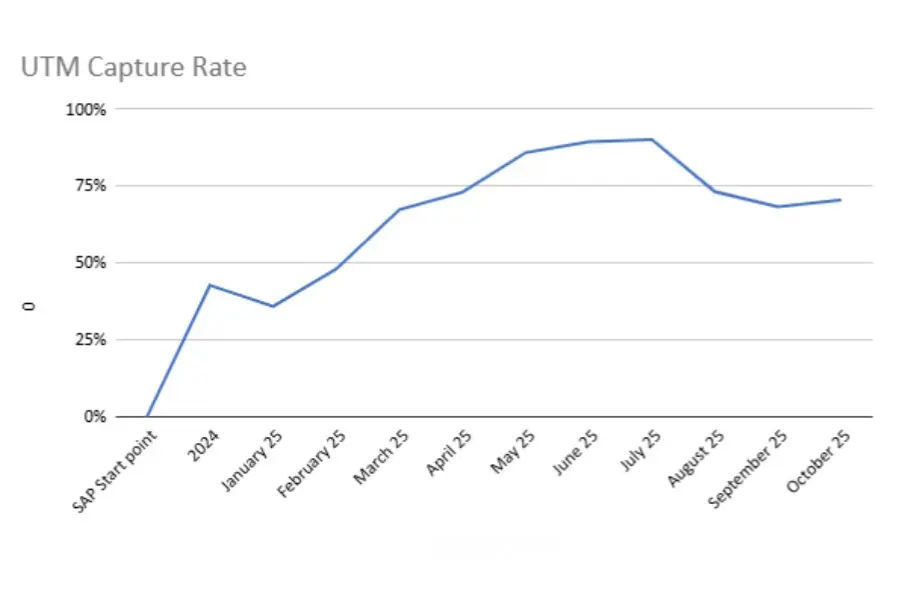


We began with no transparency into the data.
We then moved to having data available, but only through high-effort, manually created reports.
After improving our processes, reporting became more frequent and far less time-consuming.
Today, all stakeholders have daily access to key information, without teams needing to spend time collecting, cleaning, or visualizing their most important KPIs, all within SAP.
Conclusion & Next Steps
Our client’s transformation shows what becomes possible when a company takes control of its own data. By moving from zero visibility to a fully connected, privacy-first tracking ecosystem, they unlocked the clarity, efficiency, and strategic advantage that modern marketing demands. With UTM capture rates rising from 0% to +70%, a 43-point jump in Lead-to-MQL ratio, and daily automated reporting available to every stakeholder, first-party data has become a true growth engine.
The lesson is clear:
In a world without third-party cookies, the companies that invest in first-party data will be the ones that win.
If your organization is still struggling with incomplete attribution, unclear lead sources, manual reporting, or disconnected systems, this is the moment to act. You don’t need more data—you need the right data, structured in a way that gives you full control, complete visibility, and the ability to activate insights across every channel.
Start building your competitive advantage today.
Invest in your first-party data, create transparency, and transform your marketing into a system that learns, scales, and delivers results—just like our client did.