
Case Study · Google Ads in the Healthcare Sector
How Focusing on a Workshop Reduced the Cost Per Booked Demo by 65%
An IT provider in the healthcare sector had an Google Ads account that had grown to eight campaigns and featured a conversion setting that rewarded the wrong type of sale. After two months of follow-up, we were invited to conduct a workshop. Eight weeks after the redesign: more than twice as many demos as the sales team actually wants, with 22% lower spending.

65 %
lower cost per booked demo with a smaller budget
Every client account drifts off course. The question is, who notices it first?
No customer account is set up poorly from day one. It’s set up well, and then requests start coming in. A new product needs its own campaign. A target audience needs its own budget. A topic gains importance and is spun off. Every request makes sense on its own.
After two years, one client was running eight campaigns with a monthly budget of €8,700. The highest daily budget was €45—too small for Google to learn from. The conversion setting counted everything: e-commerce orders, demo bookings for obsolete products, and form submissions. Google optimized for the cheapest option. That’s exactly what it’s supposed to do.
But we sounded the alarm.
The account before the workshop
8
campaigns sharing a monthly budget of €8,700
59
conversions reported over eight weeks
5
of which were the conversions the sales team actually wanted
13 %
search impression share, with 56% of those lost due to ad rank
About the client
A German provider of secure connectivity infrastructure for the healthcare sector. The company serves two very different markets simultaneously. Medical practices purchase a standalone installation and are supported by the standard sales team. Software providers and system integrators resell the infrastructure as part of their own products, have technical questions, and generate a much higher order value through a separate sales team.
For Google, these are two different worlds: a small practice manager and a large software company. The account had to serve both with a monthly budget of 8,700 €.
The challenge: eight campaigns, a budget that was far too tight
- Fragmentation without a budget: Eight campaigns, daily budgets ranging from 25 € to 45 €. Not a single one of them collected enough data to properly implement a bidding strategy.
- A conversion setting that mixed price ranges: Low-value e-commerce orders were grouped into the same goal as high-value demo bookings. Google aimed for volume at the lowest price—and rightly so.
- Structure blocked by internal boundaries: Budgets were allocated by topic and by target audience, so campaigns could not be consolidated. Every attempt at consolidation pushed spending toward the low-cost conversion.
- Two target audiences, one landing page: A practice manager and a software architect were directed to the same page with the same tone.
- Priorities that were never documented: Everything was important. Nothing was prioritized. This isn’t a Google Ads issue and can’t be fixed within Google Ads.
First the workshop, then the account
Our Approach
01 Confront
We said the setup wasn’t good enough
We didn’t wait to be asked. When a new point of contact took over, we laid bare the account’s weaknesses, including those that had accumulated over two years. Then we requested a workshop and, at the same time, implemented the small improvements that didn’t require a decision.
02 Prioritize
A workshop, priorities laid out in writing
The workshop achieved what no optimization effort can: it produced a written ranking of what the company actually expects from paid search and what it no longer wants to focus on. Products, target audiences, and conversions were categorized into primary and secondary groups in a single session, with the budget decision-makers present in the room.
03 Rebuilding
First the conversion settings, then the structure
We redefined the conversion settings before we even touched a single campaign. Only booked demonstrations and qualified form submissions now count as conversions. E-commerce orders and bookings for the discontinued product are still tracked, but no longer influence bidding behavior. The structure resulted from this decision: Eight campaigns were consolidated into three, organized by search intent rather than internal topics.
04 Management
Fewer budgets, sufficient signal in each
The daily budget was reduced from eight sub-budgets totaling €265 to three budgets totaling €200, with half of that allocated to non-branded search. Each campaign now collects enough conversion signals for the bidding strategy to work. The transition took place on June 9, 2026.
Eight weeks after the transition
The results
−65 %
Cost per booked demo
+120 %
Actual relevant conversions (demos and qualified form submissions)
4,2x
Conversion rate for these campaigns
2,8x
Ad visibility in search
+41 %
Click-through rate
−22 %
Media spend
The account is buying fewer but better clicks.
Impressions dropped by 63% and clicks by 47%, while the truly important conversions more than doubled. The cost per click rose from €3.27 to €4.78—and that’s exactly the point: We stopped paying for cheap traffic that never led to conversions.
Visibility increased while spending decreased.
The share of ad impressions in search rose from 13.2% to 37.0%. The share of ad impressions lost due to ad rank dropped from 55.5% to 30.7%. The gain resulted from relevance, not from a larger budget.
The bidding strategy now has a foundation on which to build.
Having three budgets instead of eight means that each campaign exceeds the signal threshold required by Google. Ad quality improved on its own: the click-through rate increased by 41% without changing the creative approach.
The decisions are documented.
The results of the workshop now serve as the goal toward which we’re directing our optimization efforts. When the next request for a themed campaign comes in, there is a written list of priorities against which it can be evaluated.
Before and after
What actually changed
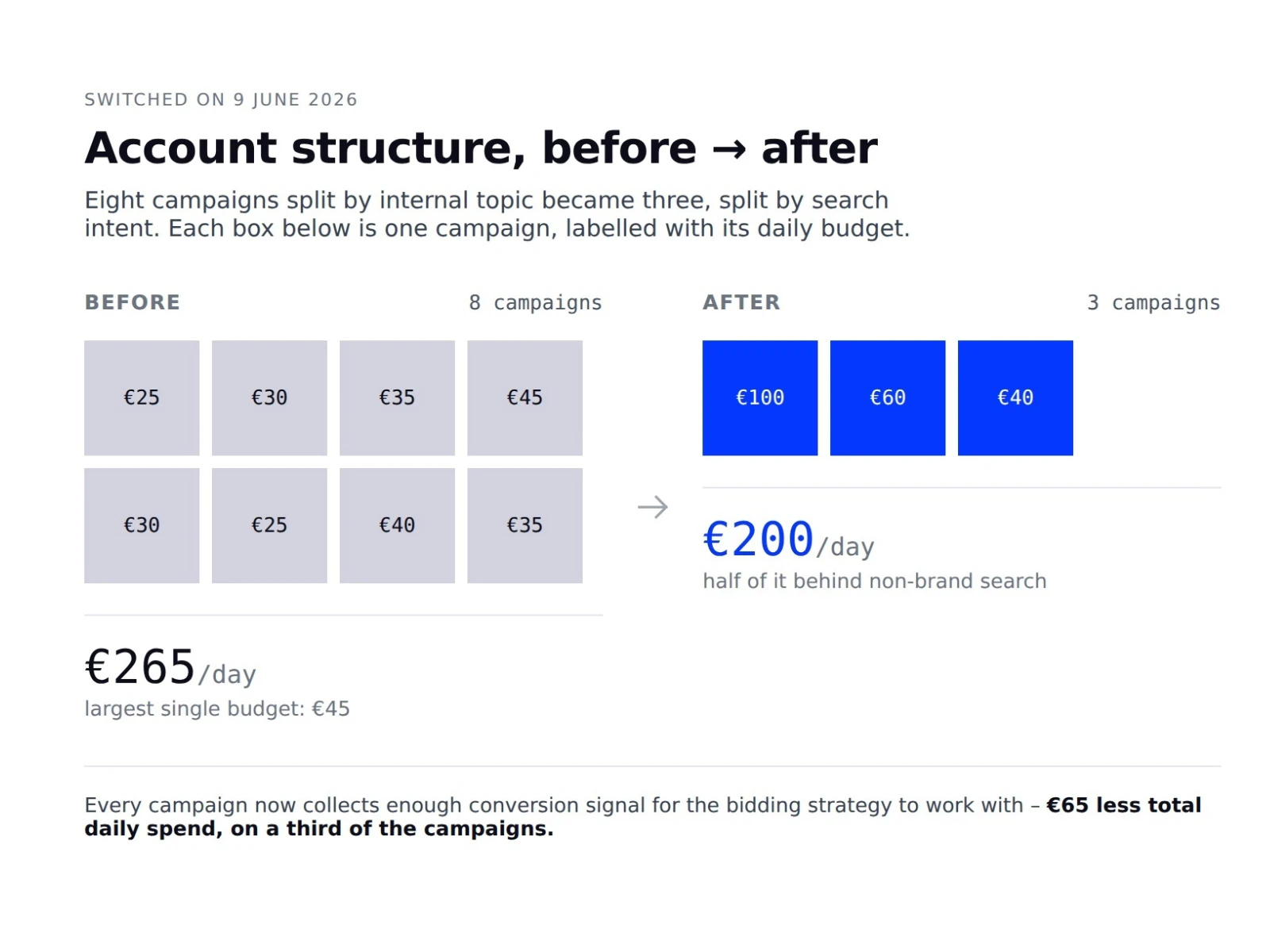
Eight campaigns with daily budgets ranging from €25 to €45 were consolidated into three. A total daily budget reduction of €65, but each campaign now generates enough signal for the bidding strategy.
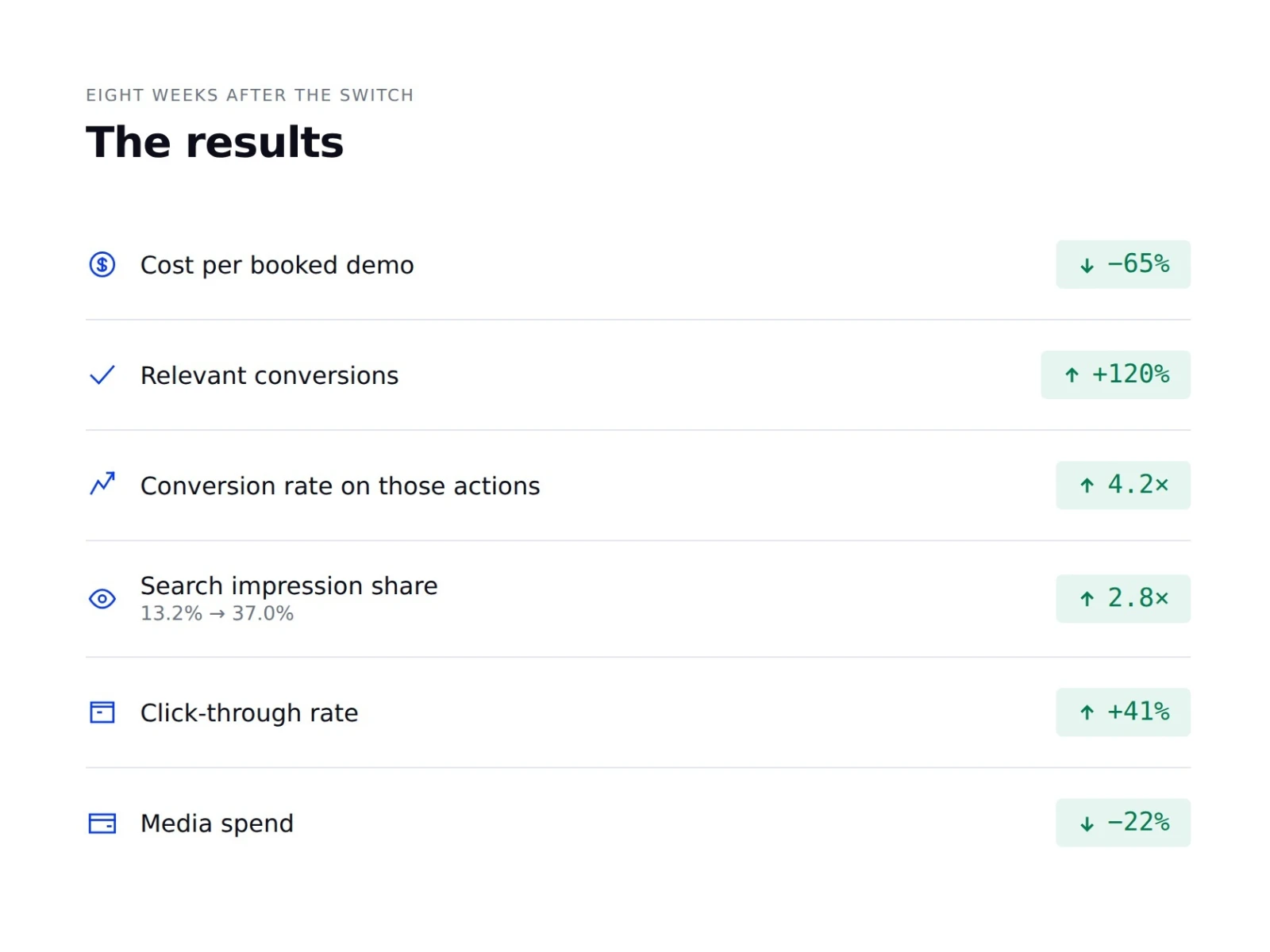
Eight weeks after the change: 65% lower cost per booked demo, 120% more relevant conversions, and nearly triple the visibility in search—with 22% less spending.
What we’re still waiting for
The redesign has shifted the metrics we can control. Three things are beyond our control, and each is worth more than the next round of bid adjustments.
- Lead value and qualification data: We’re optimizing for a booked audience. We still don’t know which audiences turn into customers. Feedback from qualification data in the CRM would allow us to bid based on value rather than volume.
- Landing page iterations: A practice manager and a software architect still land on the same page with the same tone. Separating them is by far the biggest untapped lever for conversion in this account.
- Display ad creatives: The display campaign hasn’t been updated yet because the assets aren’t ready.
None of these measures are blocked by the budget. They’re blocked by capacity and internal processes—that’s the reality of most agency work.
Your client account isn’t underperforming. It’s over-organized.
Most client accounts we take on aren’t poorly structured. They’re the result of years of reasonable requirements. This can be fixed, but not within the client account itself. It starts with prioritizing what actually matters. Talk to Kemb, and we’ll create this list together with you.