

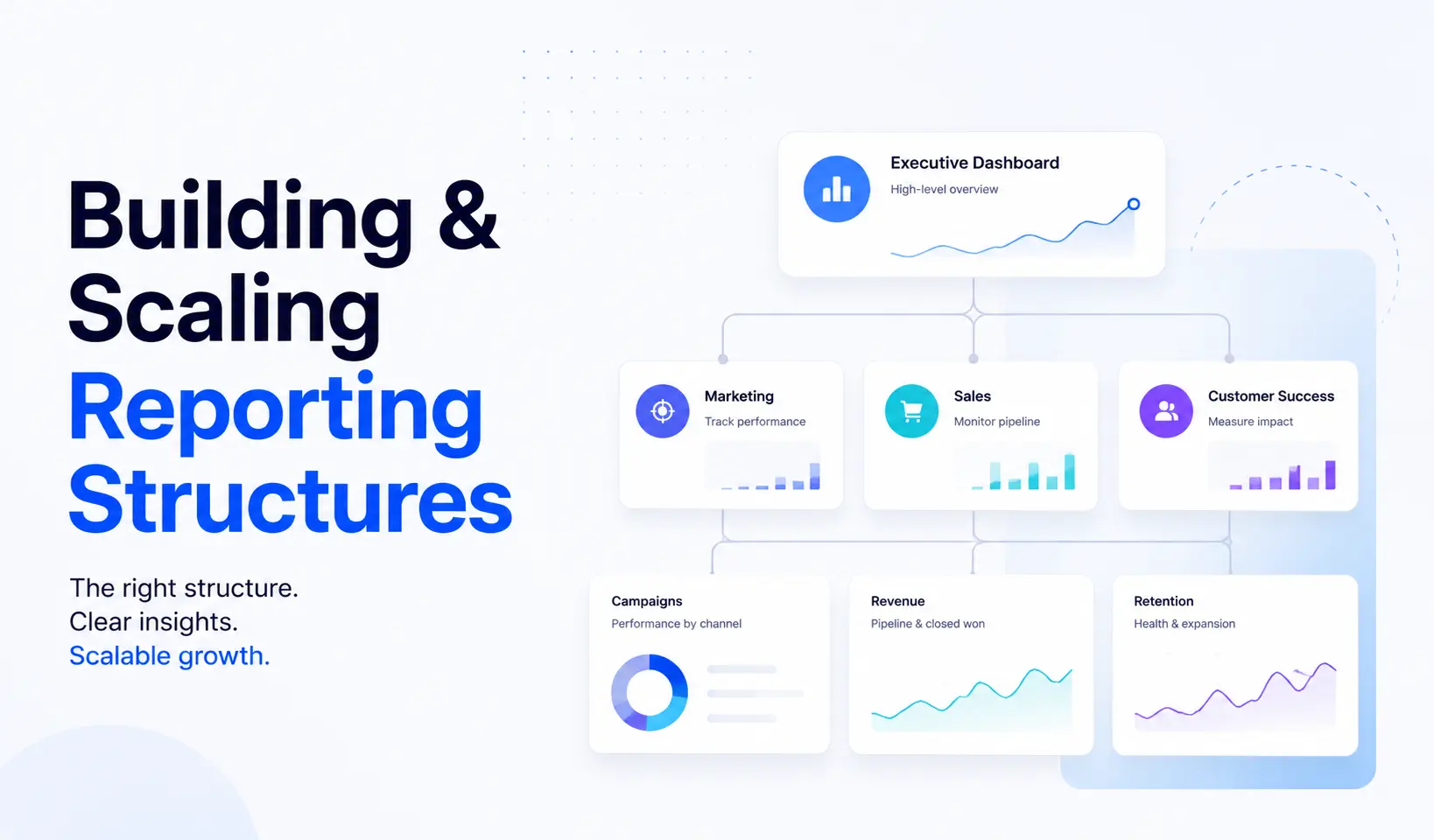
Reporting is not a project, it’s system architecture
Many companies invest a lot of time and money in reporting, yet still find themselves frustrated: Reports are read too late, dashboards are full but meaningless, and decisions continue to be made based on gut feeling. Why?
Because reporting is often thought of as a short-term tool rather than a strategic system that grows with the company.
At a time when data volume, complexity, and speed are increasing, it is not enough to simply create reports. Scalable reporting structures are needed that reliably make relevant information available where decisions are made: in marketing, management, product development, and sales.
In this article, we show you how to systematically build reporting, anchor it in processes, and make it technically scalable: with clear responsibilities, a well-thought-out infrastructure, and a setup that grows with your organization.
If you would like to familiarize yourself with the topic first, we recommend the article What is marketing reporting?. Here you can learn how reporting works as a strategic management tool.
Targeted reporting: For whom, actually?
Not all KPIs belong in every report. What is helpful for operational teams may be unnecessarily detailed—or simply incomprehensible—for management. Reporting that is aimed at “everyone” often ends up being irrelevant to everyone.
Scalable reporting therefore requires a clear target group orientation. And not just formally (marketing vs. sales), but along the decision-making levels:
-
Operational: e.g., performance marketing teams that manage ROAS, CPL, or conversion rates in day-to-day business
-
Tactical: e.g., team leads who evaluate quarterly targets and channel strategies
-
Strategic: management or investors who assess long-term trends, efficiency, and growth potential
Each of these groups needs information with different levels of granularity, in different contexts, and in appropriate formats. While dashboards are helpful for operational roles, strategic reports often require additional interpretation and commentary.
In practice, this means that a good reporting setup distinguishes between recipients and aligns structure, KPIs, and formats accordingly.
Our article on the difference between reporting and dashboards illustrates this very clearly. It shows why it is not a question of “either/or,” but rather of targeted combination.
If you want to set up scalable reporting, you should therefore ask these questions early on:
-
Who makes which decisions and which metrics support them?
-
Which roles need access to which information and how often?
-
How much context is necessary to turn numbers into action?
These preliminary considerations pay off. They prevent reporting from developing along departmental or tool lines and instead ensure it develops along decision-making logic lines.
KPI governance: When reporting fails due to questions of definition
Many reporting processes appear well structured at first glance, until two teams interpret the same metric differently. Conversion rate, ROAS, engagement score: If there is no uniform definition, KPIs lose their control function. And with them, the entire reporting process.
This is exactly where KPI governance comes in.
What is KPI governance?
KPI governance refers to the structured handling of key performance indicators in a company. It ensures that KPIs:
-
are uniformly defined and documented,
-
are regularly reviewed and updated,
-
are subject to clear responsibilities,
-
and are communicated in a comprehensible manner throughout the organization.
Without this basis, misunderstandings arise, meetings become inefficient, and reports are useless because no one trusts them.
Typical problems in practice
-
Unclear KPI responsibility: Who is responsible when a metric changes?
-
Versioning chaos: Old definitions in reports, new ones in the BI tool, both in circulation.
-
Lack of documentation: No central location where KPIs are explained, calculated, or historized.
-
Non-transparent data sources: It is unclear where the number comes from or why it has changed.
The result: KPI confusion, data discussions instead of decisions, lost trust.
What does good governance look like?
A functioning reporting setup needs not only good KPIs, but also a process that makes them maintainable and connectable. A solid governance framework therefore includes:
-
a central KPI manual or data catalog,
-
clear responsibilities for definition and maintenance,
-
standardized naming conventions and data source mappings,
-
regular review cycles, and coordinated release processes.
A good starting point is the introduction of a modern data catalog that not only documents key figures but also makes it possible to trace where each figure comes from and what it is used for.
In this article, we show how such a catalog contributes to business success in concrete terms.
If you want to scale reporting, governance is essential. It’s not about maximizing control, but rather reliability. Because only when KPIs are defined in a stable manner can reporting grow efficiently.
Processes & routines: Anchoring reporting in day-to-day business
Good reporting isn’t found on the server. It’s on the agenda.
Even the best-designed KPI framework and the cleanest data structure are of little use if reporting does not reach the place where decisions are made – in the everyday work of the teams. This means that reporting must be integrated into workflows and used regularly. Without this step, it remains a theoretical system with untapped potential.
Reporting is not a monthly PDF, but a working tool
Reporting only works as a control instrument if it is part of recurring routines:
-
Weekly performance checks in the marketing team
-
Monthly funnel reviews with sales and BI
-
QBRs (Quarterly Business Reviews) with management
These formats create a natural place for data – and increase commitment. Numbers are not only shown, but discussed, questioned, and translated into action.
From ad hoc to standard: How to make reporting process-oriented
1. Define fixed frequencies: Who receives which reports when and in what format?
2. Differentiate recipients: Not every role needs the same thing – operational team ≠ C-level.
3. Clarify responsibilities: Who prepares, who interprets, who makes decisions?
4. Integrate review & feedback: Reporting thrives on being further developed.
An anchoring in processes also protects against the classic problem: KPI reporting that is only done “for the sake of it” – but has no consequences for action. Reporting that is intended to have an impact must be consciously integrated into decision-making processes.
You can find out which key figures are suitable for this and how they can be grouped sensibly in the article on KPI selection in reporting.
Best practice: Structure beats spontaneity
Companies that scale reporting sustainably work with fixed jour fixes, clear dashboards, and annotated reports instead of screenshots in Slack.
The goal here is not control, but clarity: Those who need to know something know it. And those who need to make decisions have the basis for doing so.
Data structure & setup: The technical foundation of scalable reporting
At first glance, many reporting problems seem to be related to tools – but in reality, the cause often lies one level deeper: in the database.
If KPIs are calculated inconsistently, data is maintained manually, or sources are connected inconsistently, even the best BI tool won’t help. Scalability does not begin with visualization, but with architecture.
Three technical prerequisites for stable reporting:
1. A central, versioned data source → No copies in spreadsheets, no copy-paste in PowerPoint, but a clear “single source of truth” – for example, via a data warehouse such as Snowflake or BigQuery.
2. Automated data flows (ETL/ELT) → Tools such as Fivetran or Airbyte ensure smooth data connectivity. Modeling and transformation are ideally performed using dbt – transparent, versionable, testable.
3. Separation of logic and visualization → Business logic (e.g., metric definitions) does not belong in the visualization tool, but in a central data model. This ensures consistency across dashboards, reports, and departments.
Those who cut corners here will pay twice later – in the form of maintenance costs, ambiguities, and shadow reporting.
A clean technical foundation is not a luxury, but a prerequisite for scalable BI. We show what modern data infrastructure looks like in practice in this article on data catalogs and their impact on business success.
Typical setup mistakes:
-
Visualization before modeling, i.e., BI tools are used before it is clear what logic they should represent
-
KPI definitions maintained directly in tools, with the result that each department uses its own calculations
-
Unstructured data sources without governance, leading to data inconsistencies and a lack of transparency
A solid setup can be recognized by the fact that new reports or dashboards are not “built” but parameterized. The difference: the system is prepared – the effort lies in the question, not in data handling.
Tools & scaling: using technology correctly
Choosing the right reporting tool is not the first step, but it is a crucial one. Once the structure and processes are in place, the technical implementation determines how efficient, automated, and accessible a reporting system really is.
Many companies start directly with a visualization tool, such as Power BI, Looker Studio, or Tableau, and build their first dashboard on it. What initially looks like progress often becomes a burden later on: inconsistent metrics, manual workarounds, lack of governance.
Scalability does not come from tools, but from the interplay of structure, automation, and the sensible use of the right platforms.
What really matters when choosing a tool
It’s not about design or the favorite solutions of individual departments. The decisive factors are:
-
How well does the tool fit with the existing infrastructure?
-
Does it support automation and reusability?
-
Can different target groups work efficiently with it?
A few typical scenarios:
| Tool/Plattform | Suitable for reporting purposes |
| Power BI | Easy to integrate into Microsoft stacks, governance-ready |
| Looker Studio | Quick to deploy, particularly suitable for marketing and web analytics |
| Tableau | Strong in exploratory analysis and custom visualizations |
| dbt + Cloud Warehouse | For centralized modeling and automated reporting logic |
A detailed evaluation of these and other options can be found in the article “Data visualization tools compared”. Ideal for teams that need to choose between platforms or rethink existing setups.
Automation as a scaling factor
Scalable reporting means that new requirements do not necessitate a new project. Instead:
-
Centrally maintained KPI definitions, e.g., in dbt or a data catalog
-
Automated report output via dashboards, slides, or PDF
-
Role-based output formats for different stakeholders
A well-thought-out setup enables, for example, monthly funnel reports for management and daily performance dashboards for marketing based on the same data, but with customized displays.
The tool stack is not the goal but the means
Reporting tools only reach their full potential when data is cleanly structured, processes are clarified, and requirements are well thought out. The best solution is therefore rarely the one with the most features, but the one that fits seamlessly into a company’s data and decision-making ecosystem.
Conclusion: Reporting grows with structure, not with effort
A scalable reporting system is not created by constantly adding new dashboards or even more KPIs. It is created by clarity in structure, processes, and data logic.
The crucial questions are not:
“Which tool should we use?”
or: “How often do we want to report?”
But rather:
-
What needs to be decided?
-
What information is relevant for this?
-
How can we ensure that this information is available, accurate, and understandable at all times?
If you think about reporting from the perspective of these questions, you will quickly realize that scalability has nothing to do with complexity, but with focus. With the ability to deliver relevant information efficiently, regardless of how many channels, markets, or teams are involved.
Whether via an automated dashboard, curated monthly reporting, or annotated analysis in a quarterly review:
Reporting is not reporting if it does not lead to decisions.
If you are considering restructuring or scaling your reporting landscape, it is also worth taking a look at our framework for KPI selection in reporting – there we show how structure and impact can be meaningfully combined.
Do you want to build reporting structures that grow with your company, not work against it?
We support you in developing a sustainable, scalable reporting setup: structured, automated, and action-oriented. Talk to us.
Frequently asked questions (FAQ)
What does scalable reporting mean?
A scalable reporting system can be expanded without additional effort – through clear structures, automated processes, and a consistent database.
Which tools are suitable for scalable reporting?
That depends on the setup. Power BI, Looker Studio, or Tableau are frequently used – integration into data models and processes is important.
How do I start building a reporting system?
The starting point is the question: Which decisions should be supported? Only then do KPI selection, data structure, and tool use follow.
What role does KPI governance play?
A very central one—without uniform definitions, responsibilities, and documentation, reliable reporting cannot be achieved.
Can reporting scale without a data warehouse? Only to a limited extent. Without centralized, automated data management, the manual effort increases significantly – and inconsistencies become more likely.


